Aerogram : https://www.aerogram.ai/
Most GenAI Projects Failed
88% of enterprises have deployed AI. Only 5% are extracting meaningful value.
Almost every large company has AI running somewhere. Almost none are getting real results.
This isn't a technology problem. It's a strategy problem.
- The Two-Paradigm Trap: Every deployment falls between Chat UI (humans prompt AI) or autonomous agents (AI acts end-to-end). Chat UI struggles with complex workflows. Agents are inconsistent and create governance issues. What's missing? A middle ground where AI and humans collaborate with appropriate oversight.
- The Pilot-to-Production Gap: A team runs pilots. One works. Leaders tell the quick win story. Six months later, nothing has changed. A pilot that impresses executives is not the same as a system that transforms operations.
- The Infrastructure Fragmentation Problem: Every enterprise will soon run 100+ AI applications. But today, different teams use different models, tools, and approaches. No governance. No standards. No way to scale.
- The Skills Gap Illusion: Enterprises respond by training employees on prompting. Wrong approach. The gap between "I can use ChatGPT" and "I can build AI into my daily work" is enormous. The solution isn't more training. It's better infrastructure that doesn't require advanced skills to use.
Aerogram : The New Enterprise AI Stack
As leaders, what can we do about it? This is an extremely hard task. But the companies getting this right are building a fundamentally different kind of stack.
Think of it in five layers:
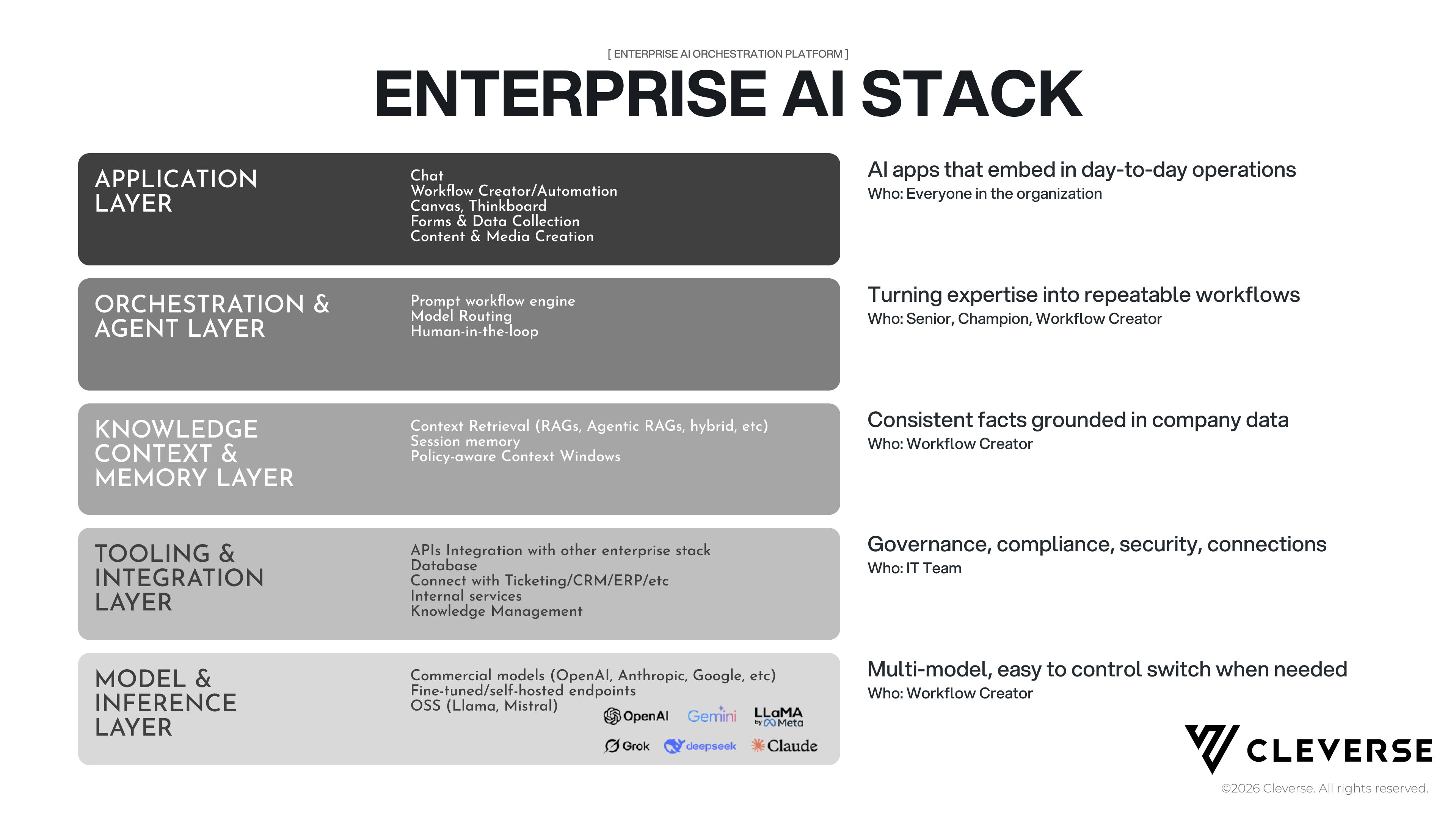
Let me break down why each layer matters and how it solves the problems I described above.
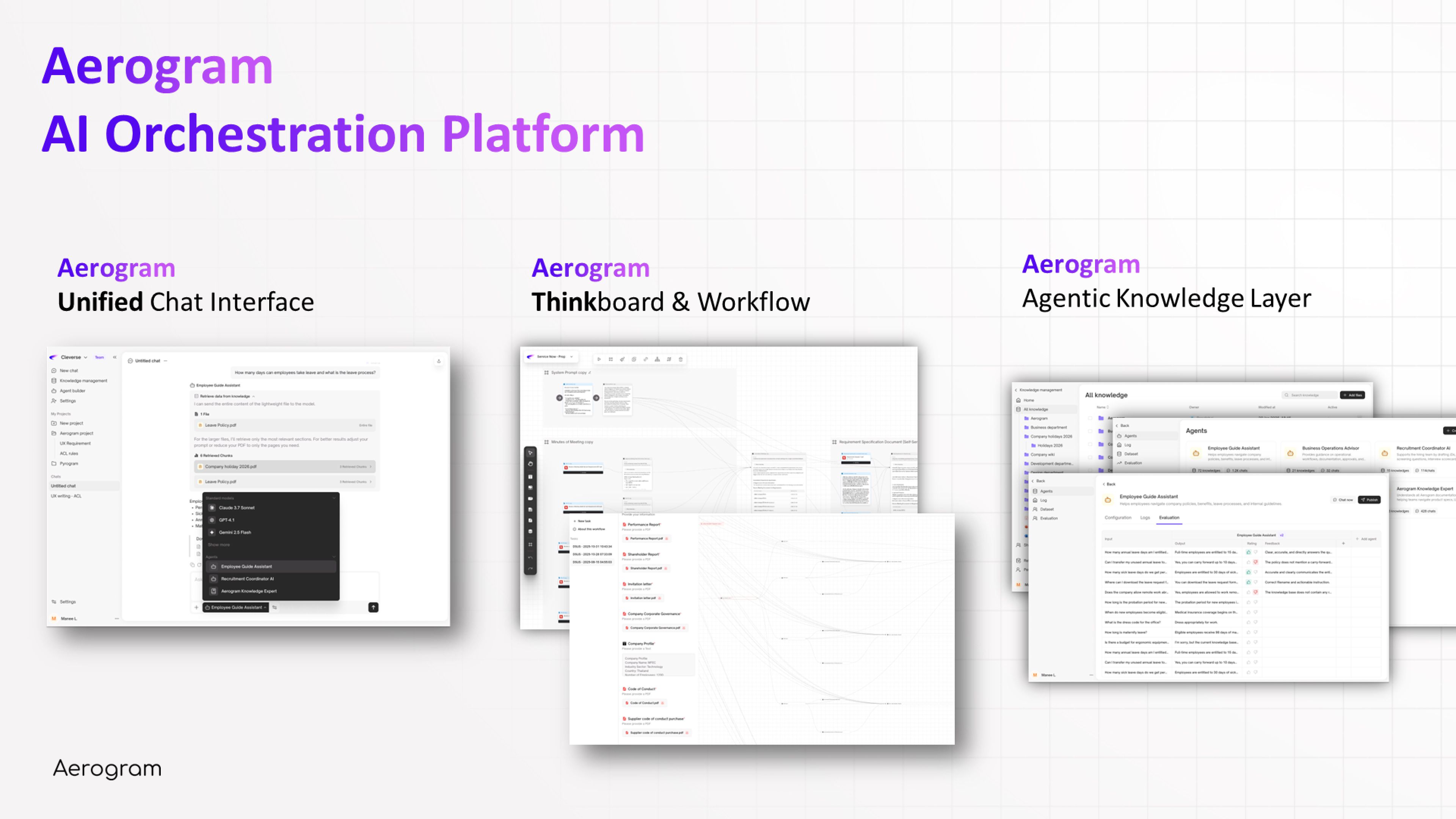
Layer 1: Application Layer
Who's involved: Everyone in the organization
Most people in your organization will never learn to engineer advance prompts. They are just trying to accomplish their job. The AI application should handle the rest.
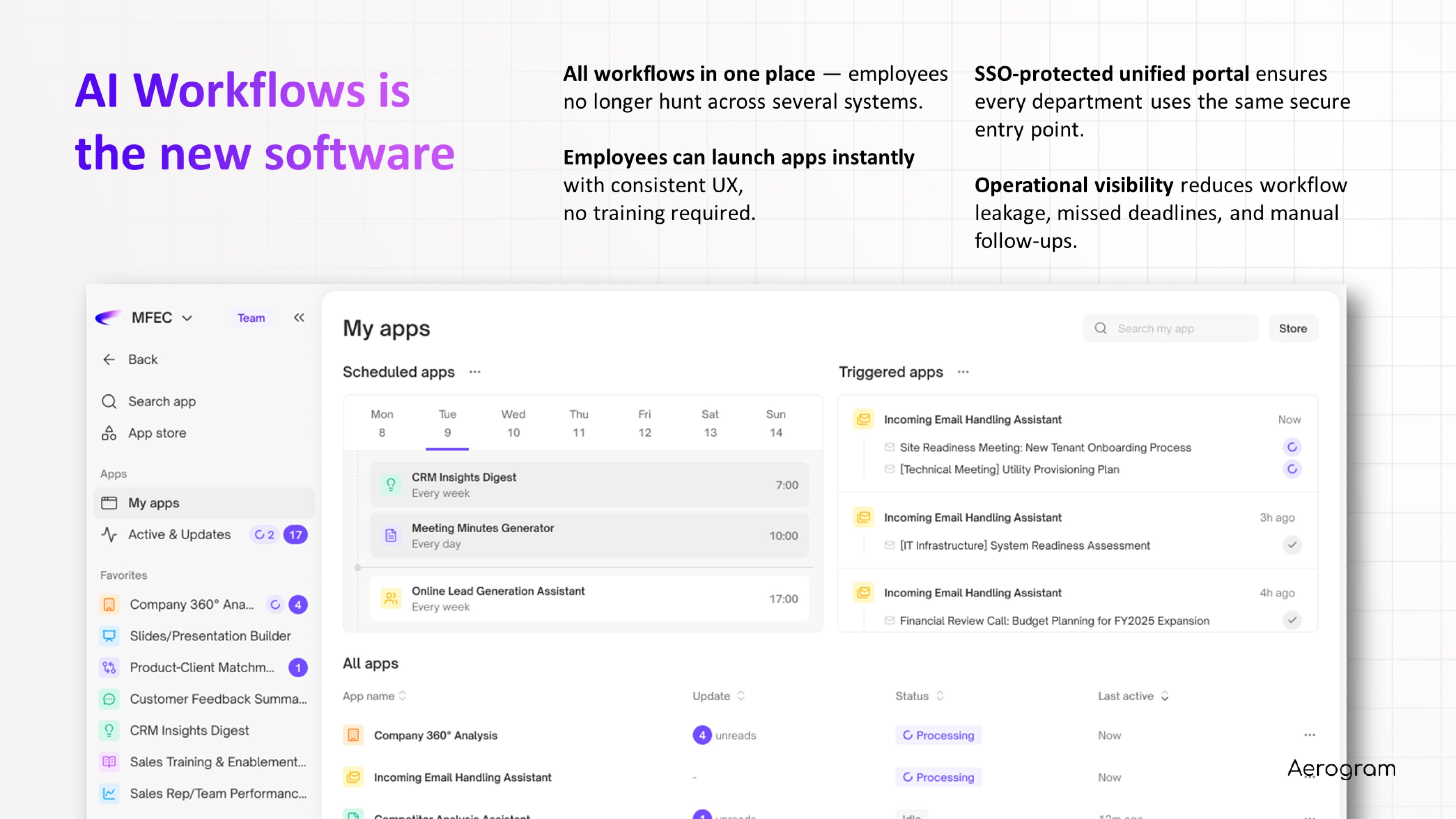
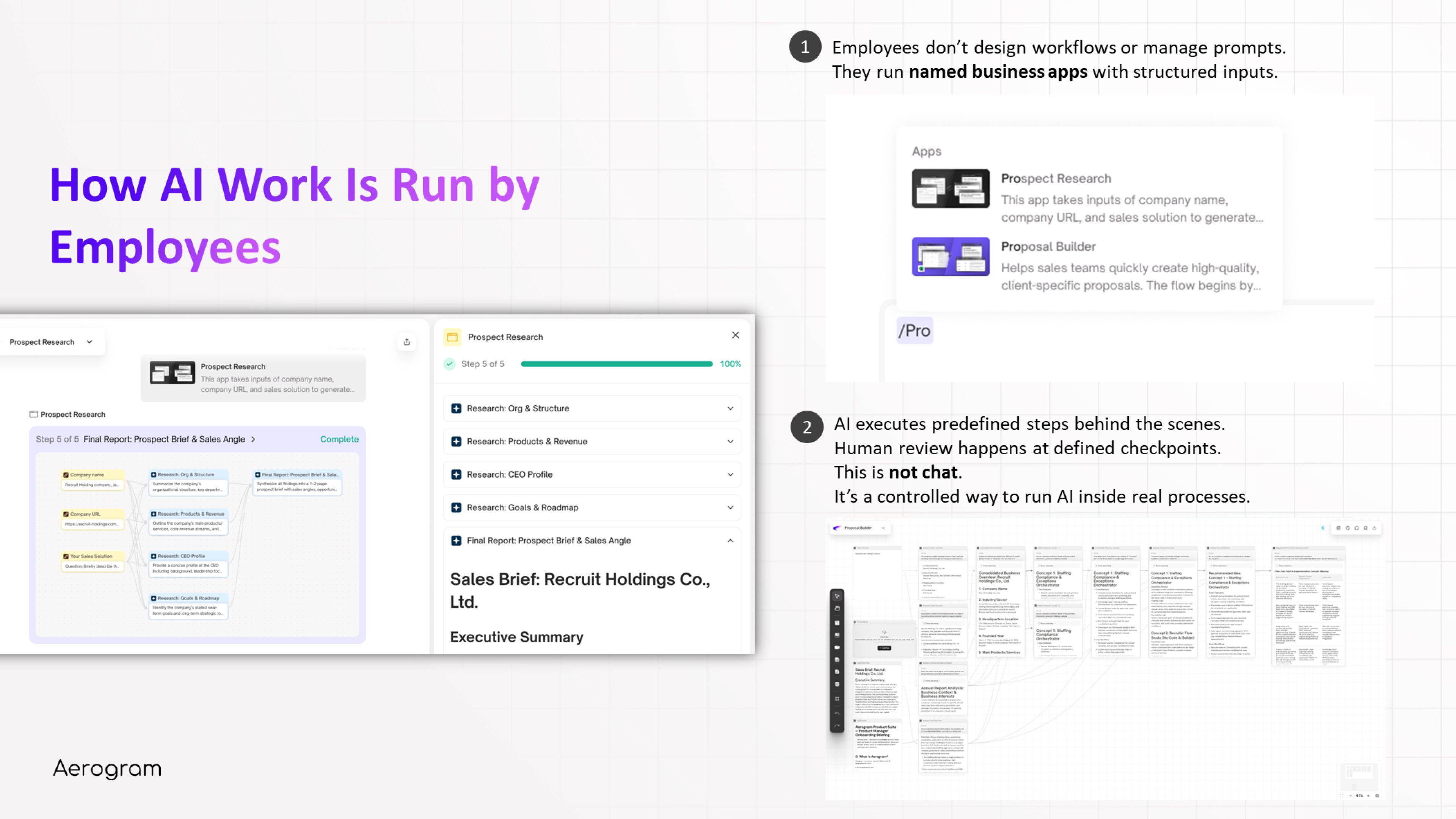
This is the shift: Instead of giving employees AI tools and expecting them to figure it out, you give them AI applications with business expertise already embedded. They choose the app for their task, fill in the required information like any other business form, and get results. No prompting. No experimentation. Just work getting done.
What this looks like in practice:
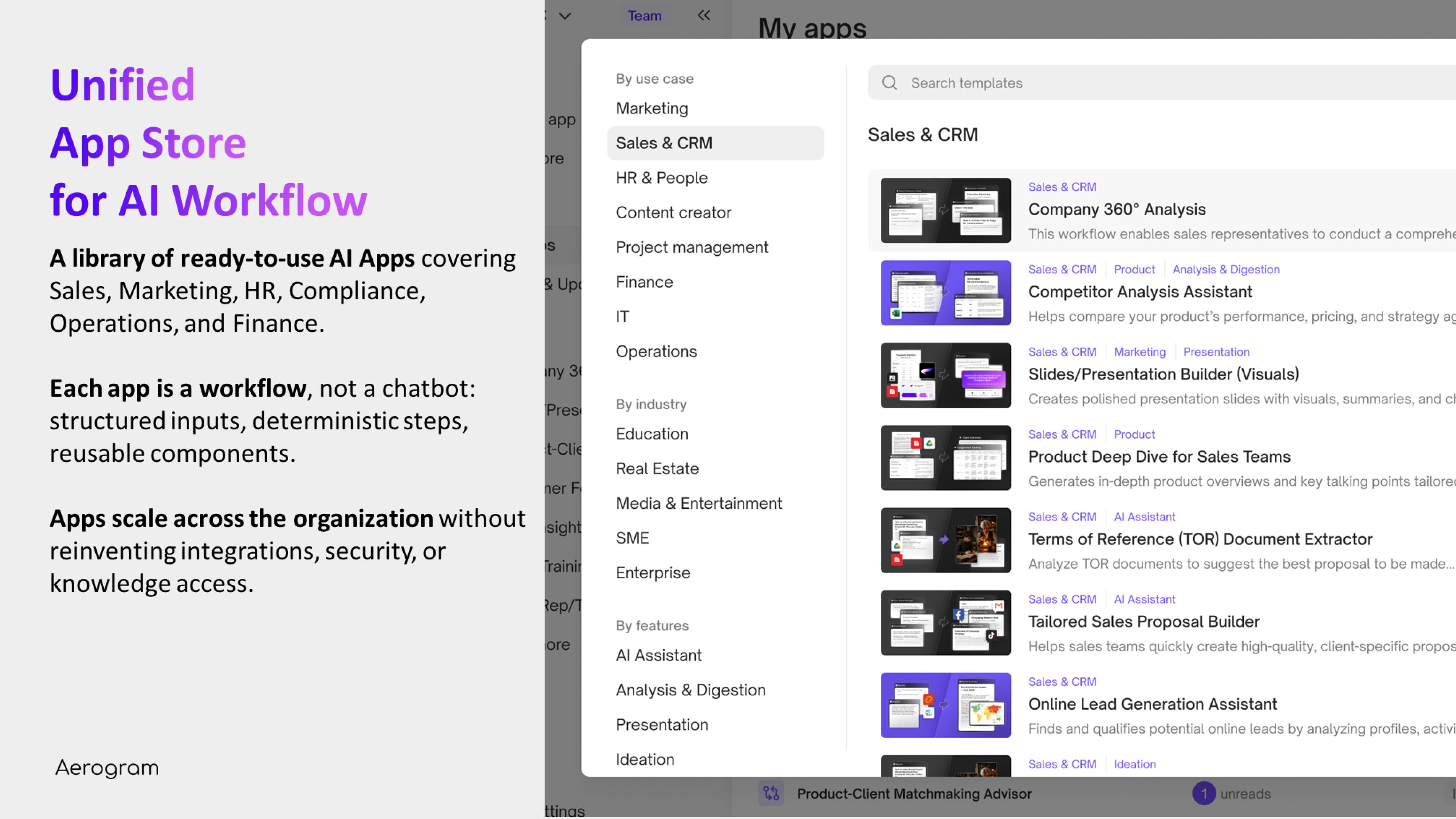
- Enterprise AI App Store: Pre-built AI applications for specific use cases
- Unified Chat: One interface that connects to all AI capabilities
- Apps accessible via forms, chat, or embedded in existing workflows
Think about the difference between "write a prompt that analyzes customer feedback sentiment" versus clicking into a Customer Feedback Analyzer app that already knows what to look for. The second approach is what drives real adoption.
Layer 2: Orchestration Layer
Who's involved: Your senior, AI champion and workflow creators.
Here's something every organization deals with: People have different levels of judgment. A junior doesn't think like a senior. A new sales rep doesn't qualify leads like a sale manager.
This isn't a training problem. It's an experience problem.
The result? Your junior people can't perform at senior levels. Your senior people become bottlenecks. And when your best people leave, their expertise walks out the door with them.
The orchestration layer changes this.
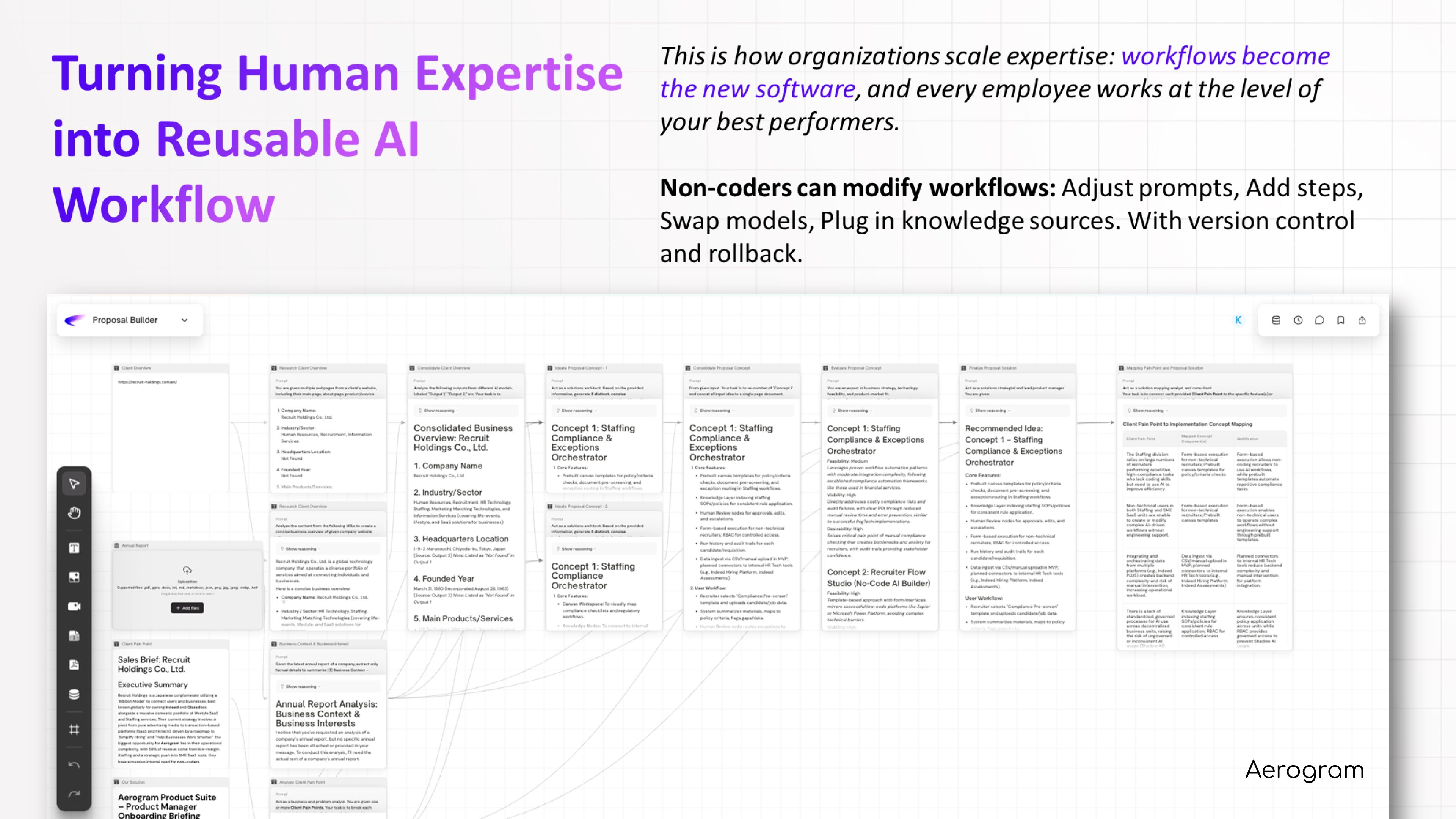
This is where the job’s experience gets extracted and turned into AI workflows that anyone can re-use. Your senior approach to financial modeling becomes a workflow. Your experienced sales rep's qualification process becomes a workflow.
But here's AI Workflow: human create process, reviews the result, and pass to the next workflow. This is the missing middle ground between "do everything yourself with chat" and "let AI run unsupervised." The AI handles the 80% that's repeatable workflow. The human handles the 20% that requires judgment. That's how you get speed without sacrificing quality or trust.
What this looks like in practice:
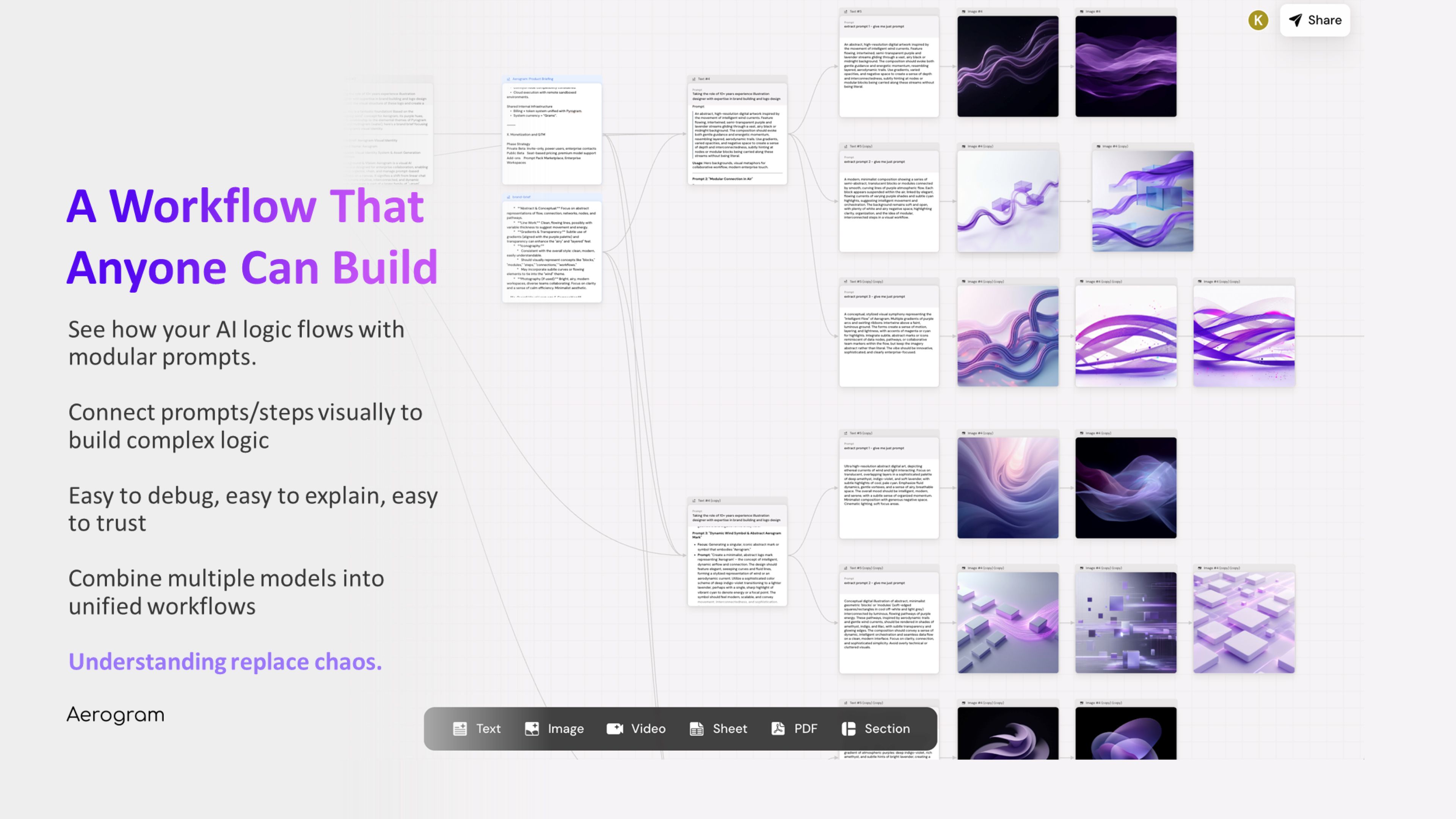
- AI Workflow: Visual tools to build multi-step AI processes
- Build App from Workflow: Turn workflows into apps that junior employees use to perform tasks at senior-employee quality
- Human in the loop
The result: Your junior team members can do work as your senior team members. Not because AI replaced expertise, but because AI captured and distributed it.
That knowledge trapped in your best people's heads? Now it lives in your system. It scales. It compounds.
Layer 3: Knowledge, Context & Memory Layer
Who's involved: Workflow creators
AI without context is just a ChatGPT. It doesn't know your company. It doesn't know your customers. It doesn't know your products, your policies, your history, your specific terminology.
Right now, knowledge in your organization is fragmented everywhere. SharePoint, OneDrive, Google Drive, or even in personal notebook.
The result? Duplication. Inconsistency. Massive maintenance burden. And AI that gives different answers depending on which app you ask.
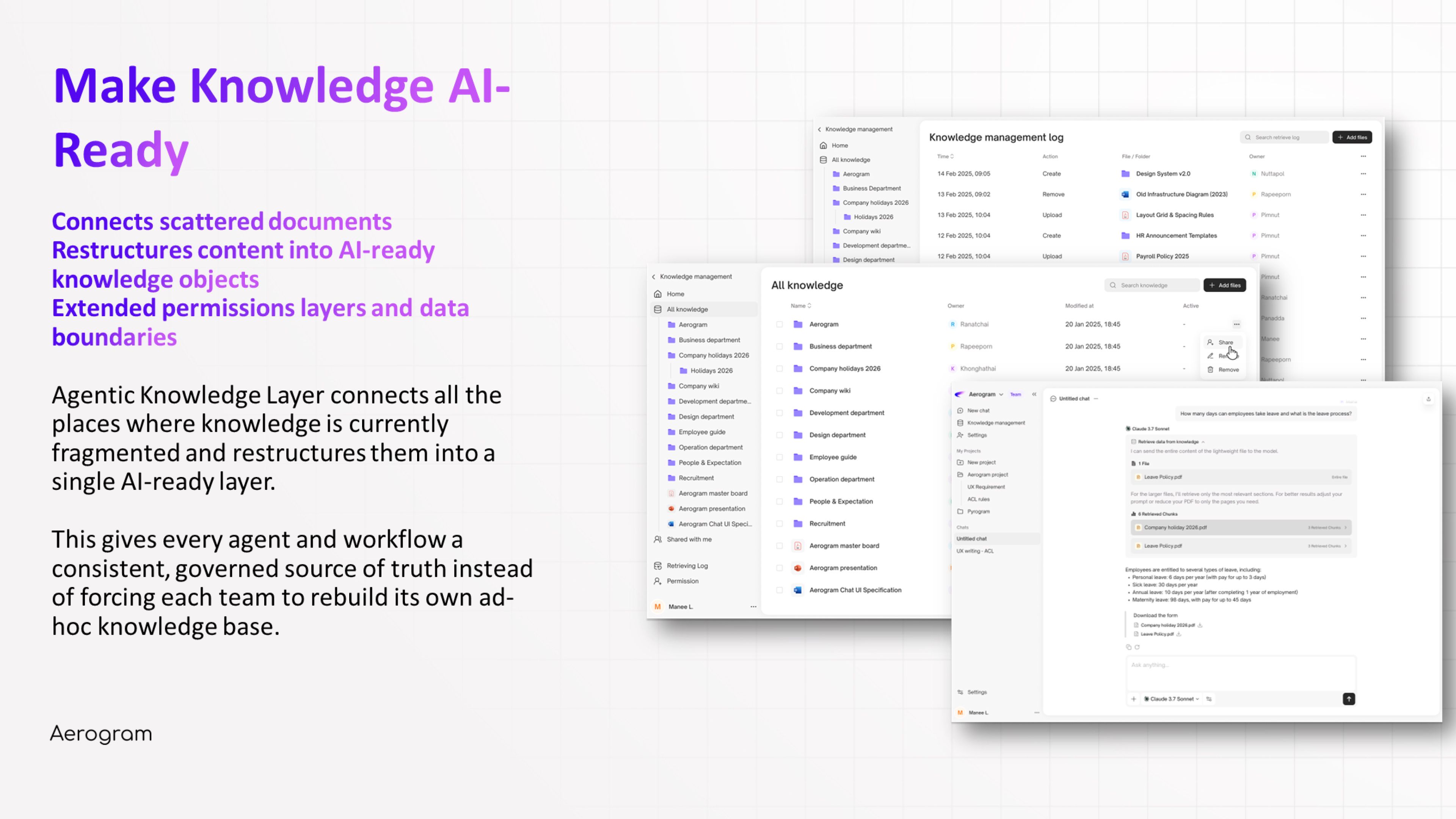
The knowledge layer connects all the places where knowledge currently lives and restructures them into a single AI-ready layer. Update the knowledge layer, and every app gets smarter simultaneously.
What this looks like in practice:
- Agentic Knowledge Layer: Automatic connections to fragmented knowledge sources and auto sync when update
- Restructured data: Company information formatted for AI consumption
Without this layer, every AI app is starting from scratch. With it, every AI app inherits the full context of your organization.
Layer 4: Tooling & Internal Integration Layer
Who's involved: IT team
This is the layer that makes enterprise adoption possible. Every IT team has the same questions:
- How do we audit who access?
- How do we ensure compliance with our data policies?
- How do we integrate with our existing systems?
What this looks like in practice:
- Advanced data policy enforcement
- SSO, RBAC, and comprehensive audit logs
- Integration with internal tools (CRM, ERP, Database, etc.)
- Governance frameworks that scale
Without this layer, AI initiatives stay in pilot mode forever. With it, IT and security can confidently roll out AI across the organization.
Layer 5: Foundation Model Layer
Who's involved: Workflow creators, IT team
Here's something most enterprises get wrong: They bet on a single model provider. Then a better model comes out. Switching is painful or impossible because it is required to migrate your whole organization chat history.
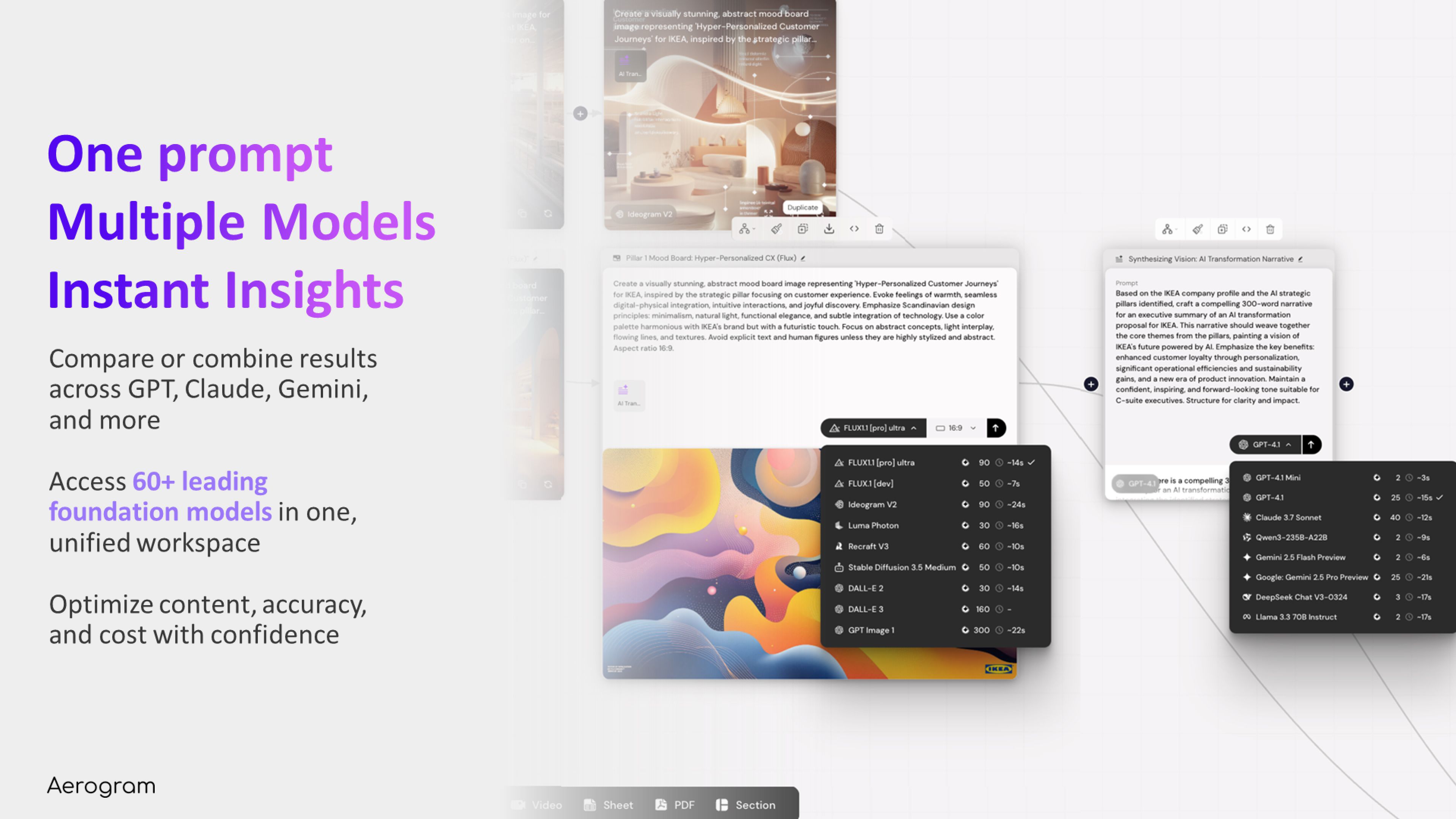
The foundation layer abstracts away model selection. You can use Gemini for general question, and Claude for writing tasks—all without rebuilding your applications.
What this looks like in practice: Multi-model by default, easy switching as new models emerge.
Model capabilities are moving fast. What works today may be obsolete in 6 months. The ability to switch models without migrating your data isn't a nice-to-have. It's essential.
The Factory Floor For Your AI
AI will not replace jobs overnight. It will show up as hundreds of small workflows across every department. Without a shared operating layer, those workflows fragment.
Aerogram is the infrastructure to build and run safe, repeatable AI workflows. It's the five-layer stack.
The enterprises that win at AI won't be the ones with the best models. They'll be the ones with the best strategy for turning AI into operational reality.
That's what a factory floor does. It doesn't invent the product. It makes the AI App repeatable, reliable, and scalable.
Don’t let busy-work bury your core business. Your AI needs a factory floor. Aerogram is it.