Forward Deployed Engineer (FDE) has become one of the hottest titles of the AI era. We see it everywhere now, in job postings and in a growing list of training programs.
The companies hiring for it tend to share a profile. They've already run AI experiments. Some pilots worked, some didn't, and they're starting to get clear on what they actually want.
But FDE is often treated as the answer. In reality, it's just the name of one.
What you actually need is to transform your organization to use AI effectively, not to hire someone with a three-letter title.
In this post, we go through:
- Why every technology shift creates a Title Trap.
- Why picking the problem matters more than solving it.
- The AI Rebuild Triad: three forces that must all be present for AI to create real business value.
- Why the team doing this work has to be "forward deployed."
- How to structure the team when you can't find one person who does it all.
Every Tech Shift Creates a Title Trap
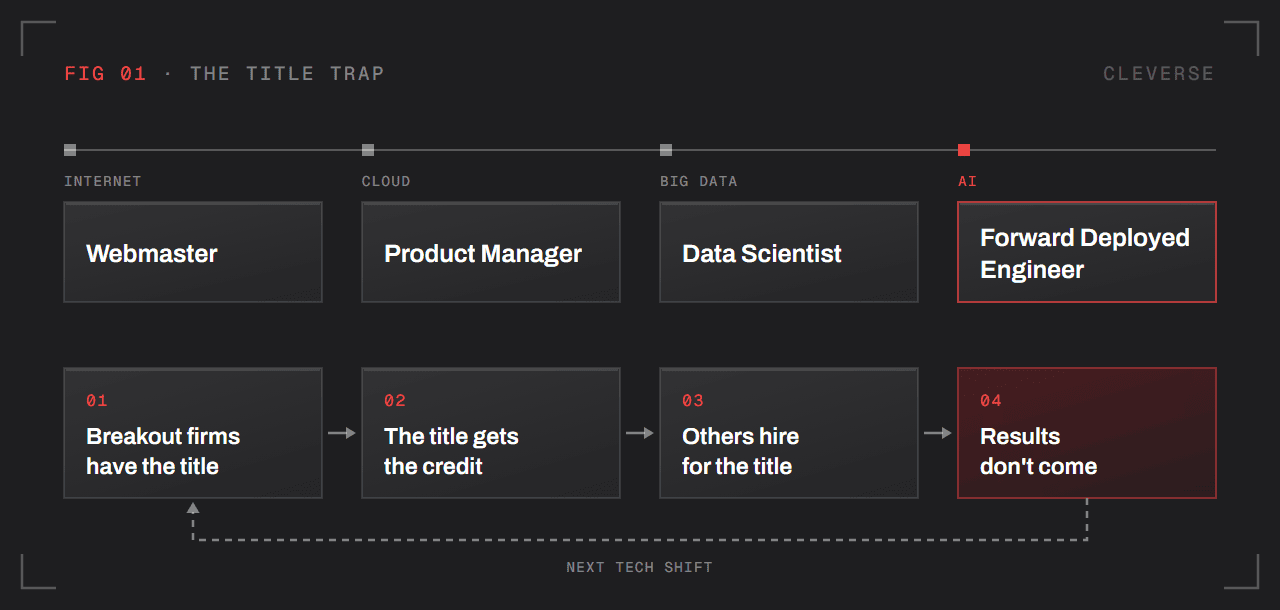
Every technology shift creates a new title.
- Internet era → Webmaster
- Cloud and product-led growth era → Product Manager
- Big data era → Data Scientist
- AI era → Forward Deployed Engineer
And every time, the same pattern repeats:
- The breakout companies of that era have people with this title.
- Everyone else sees it and concludes the title caused the success.
- They hire for the title and expect the same results.
- The results don't come, because the conditions that made the title work weren't part of the hire.
Product management is the clearest example. Companies saw the breakout software companies running on strong product teams and hired Product Managers of their own, but kept the old structure: no direct access to customers, no usage data, and no ownership of outcomes. The Product Manager ended up as a requirements writer and project coordinator, shipping whatever stakeholders asked for.
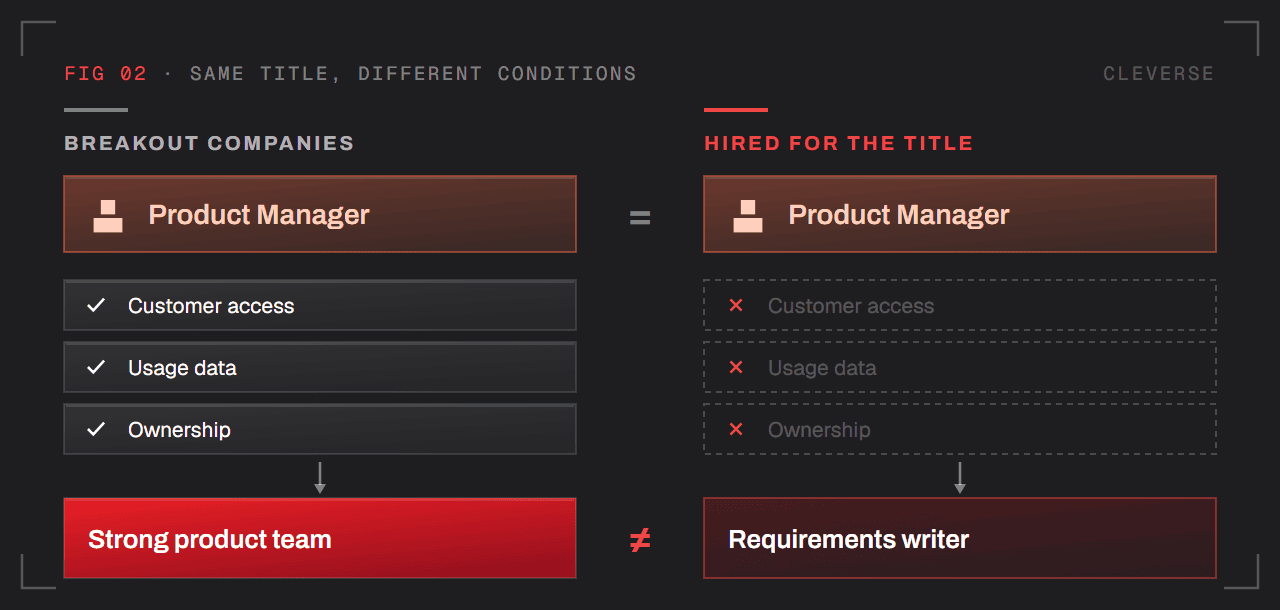
The title isn't the problem. Believing the title is the answer is the problem.
FDE is on the same path. Before you hire one, step past the title and ask what work actually needs to happen.
Picking the Problem > Solving the Problem
Engineering excellence can't compensate for picking the wrong business problem.
AI engineering is full of hard problems: accuracy, hallucination, latency, cost, scale. They all matter. But before you spend your AI engineers' valuable time, the first question should be: is what we're building worth building at all?
Example: The Document Search That Didn't Speed Anything Up
What the customer asked for
An AI tool to help employees find documents faster.
What happened
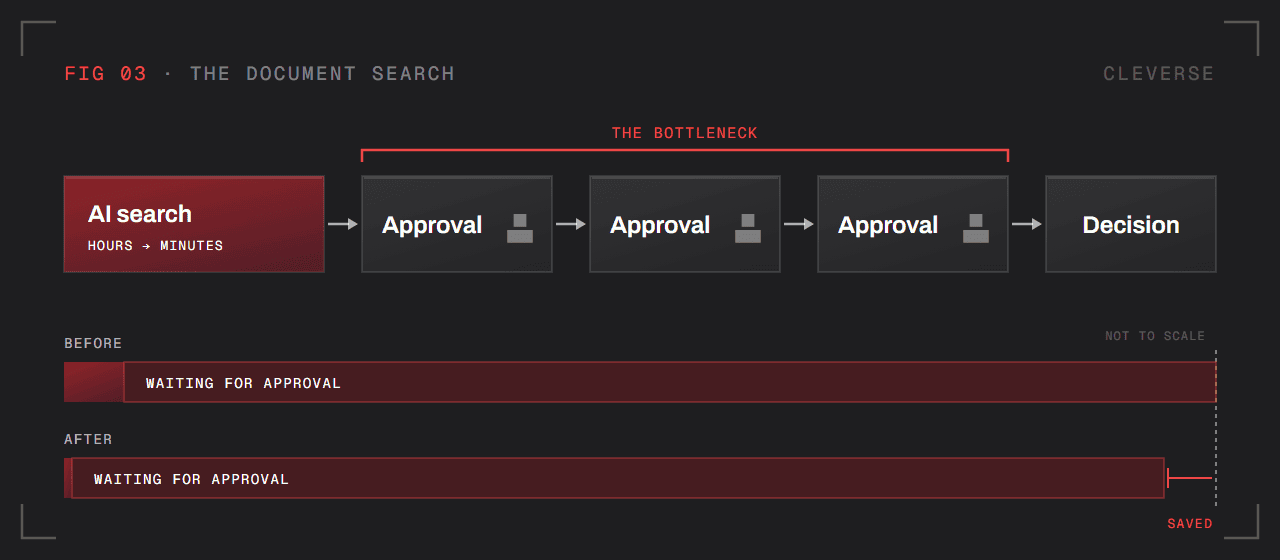
The team built a system that searches fast and answers accurately. The demo went well. Search time dropped from hours to minutes.
The problem
The real bottleneck was never search. It was decisions that had to pass through multiple departments. If a document still waits weeks for approval, perfect search barely moves the business.
Speeding up a step that isn't the bottleneck doesn't speed up the system.
The Volume Trap
Most teams size an AI use case the same way. They look at a task, put a cost or value on it, and calculate how much AI can save:
Savings = Time saved per task × Task volume × Cost per hour
Then comes the assumption that makes the math work: the people whose time was freed up will move on to higher-value work.
This is why so many AI business cases look strong on paper and still feel intangible a year later.
The better question isn't "how much does AI save on this task?" It's "what changes in the business when this task changes, and who makes that change happen?"
Picking the right problem, the one with real business value, matters more than execution.
The AI Rebuild Triad
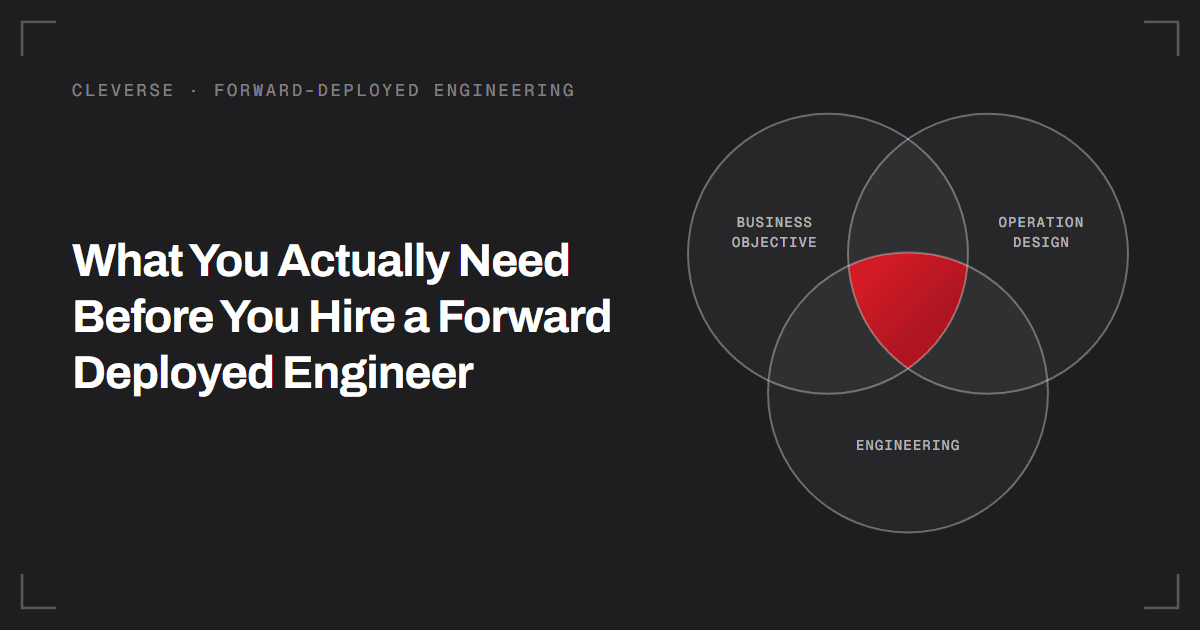
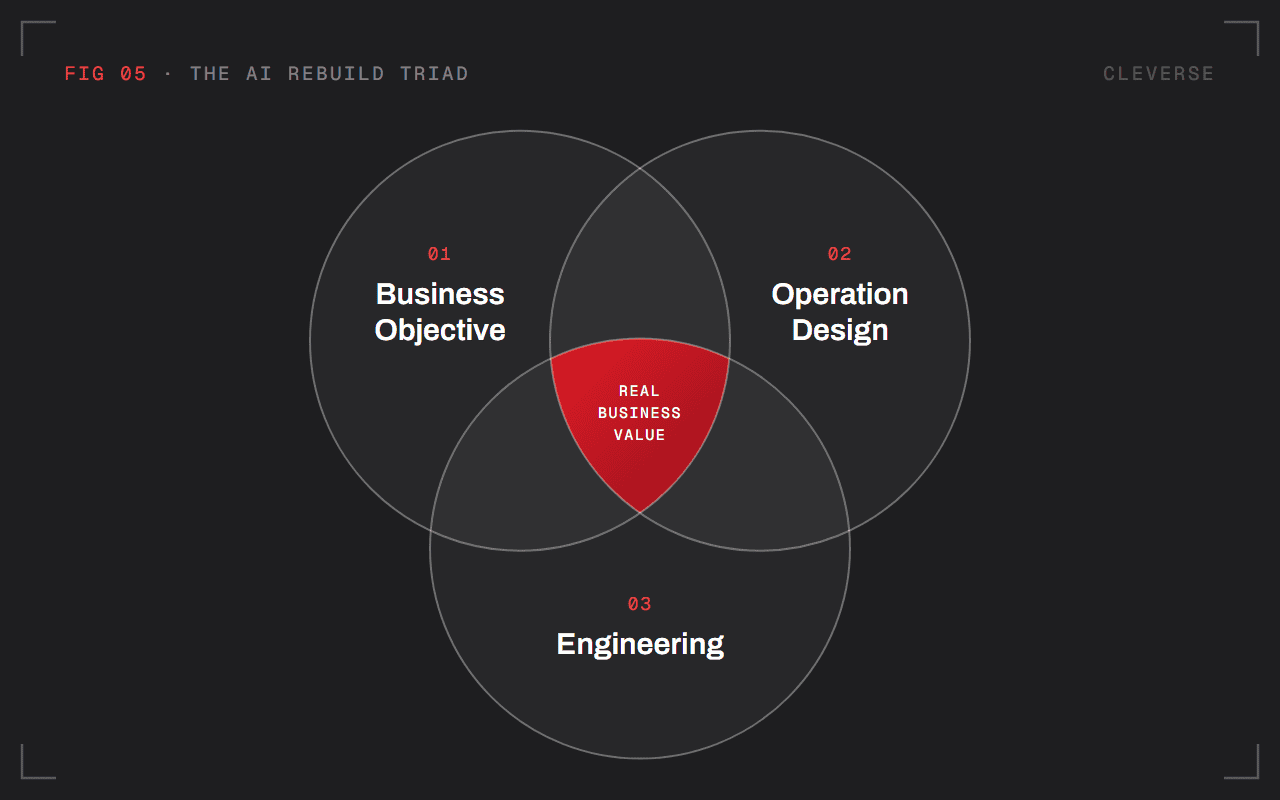
Across the organizations Cleverse has helped rebuild their AI capability, we've found that every AI initiative that creates real results sits at the center of three forces:
- Business Objective — knowing what to build
- Operation Design — redesigning how work gets done
- Engineering — making the design work in reality
Let's talk about each one.
1. Business Objective: Knowing What to Build
The first force is understanding the company's goals, the metrics departments and executives are measured on, the company's strategic moves, and the new business opportunities AI can unlock.
The most common trap here is the Productivity Trap: individual productivity ≠ company performance.
Making one person work faster doesn't always improve the performance of the whole organization. This is a big reason so many companies feel the ROI of AI is still intangible.
The problem may not be the AI. It may be that you picked a problem nobody cares about enough.
A quick test for whether a problem passes the first force:
- If this succeeds, which number on the executive dashboard moves?
- If this project were killed tomorrow, which executive would fight to save it?
- Is this the real bottleneck, or just the most visible step?
2. Operation Design: Redesigning How Work Gets Done
An agent that works doesn't mean an organization that works.
Say AI can now review documents instead of people. The questions that follow immediately:
- Who decides when the AI isn't confident?
- Who has approval authority?
- What do the people who used to review documents do now?
- How do handoffs between departments change?
- Can you remove the people entirely?
- Who's accountable when something goes wrong?
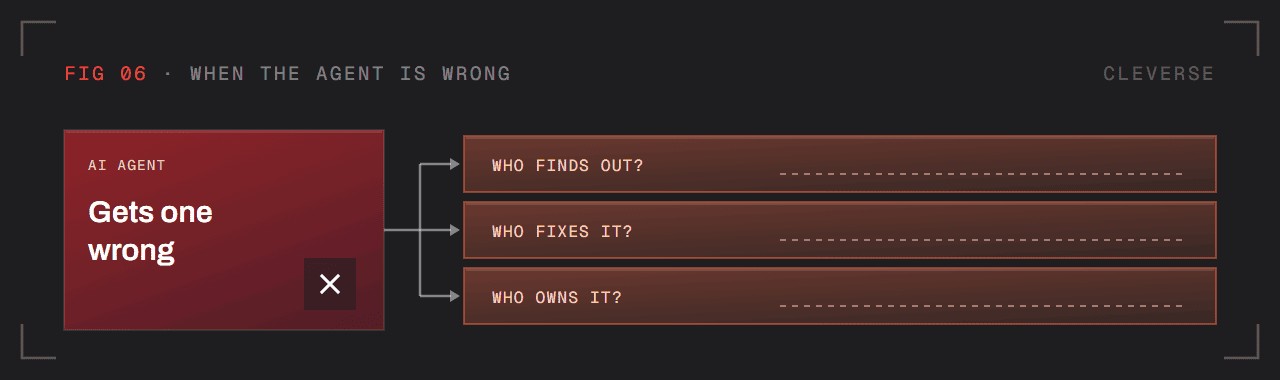
The question shifts from "How accurate is the agent?" → "When the agent is wrong, who finds out, who fixes it, and who owns it?"
3. Engineering: Making It Work in Reality
AI that answers correctly in a demo still has to survive production: data, access permissions, security, legacy system integration, latency, error handling, and scale.
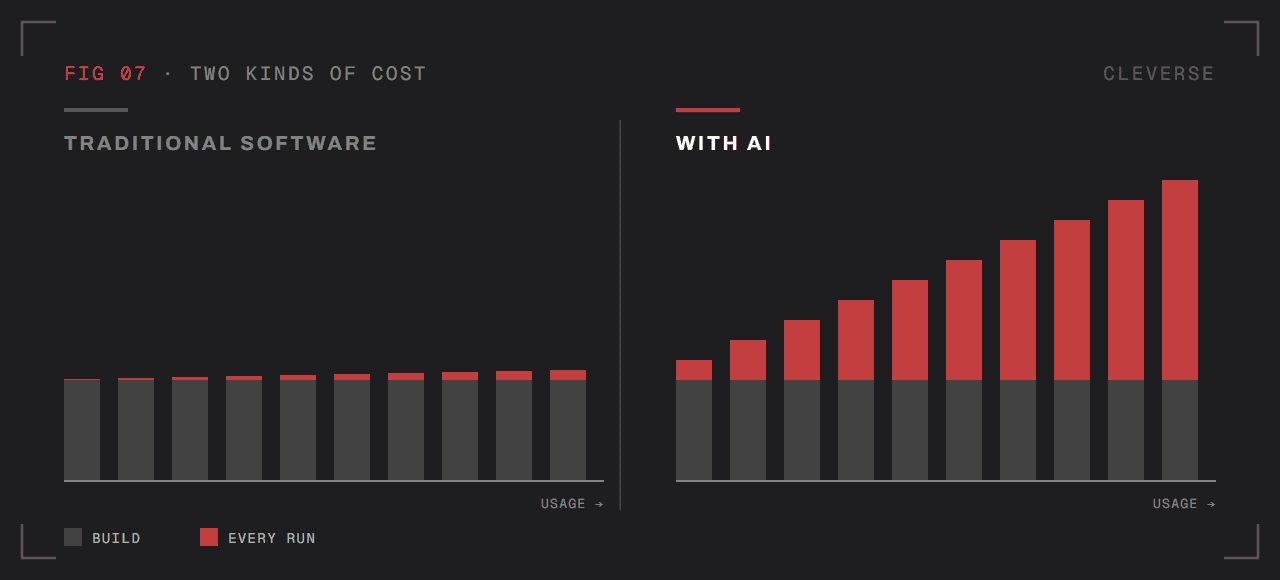
It also has to keep two kinds of cost worth the outcome:
- Initial cost — the cost to build the system
- Recurring / per-transaction cost — the cost every time the system runs
The second is the one teams most often underestimate. Unlike traditional software, AI costs money every time it's used.
Just as important: a system with AI in it doesn't need AI to do everything.
| Type of work | Best fit |
|---|---|
| Rule-based, deterministic work | Traditional software |
| High-volume data processing | Databases and Data Pipeline |
| Work that requires interpretation and flexibility | AI |
| Decisions someone must be accountable for | People |
AI capability and software engineering fundamentals complement each other. The more technologies you understand, the better you can choose the right solution for each part of the problem.
What Breaks When One Force Is Missing
Each force is necessary. None is sufficient on its own. Remove any one, and you land in a predictable failure.
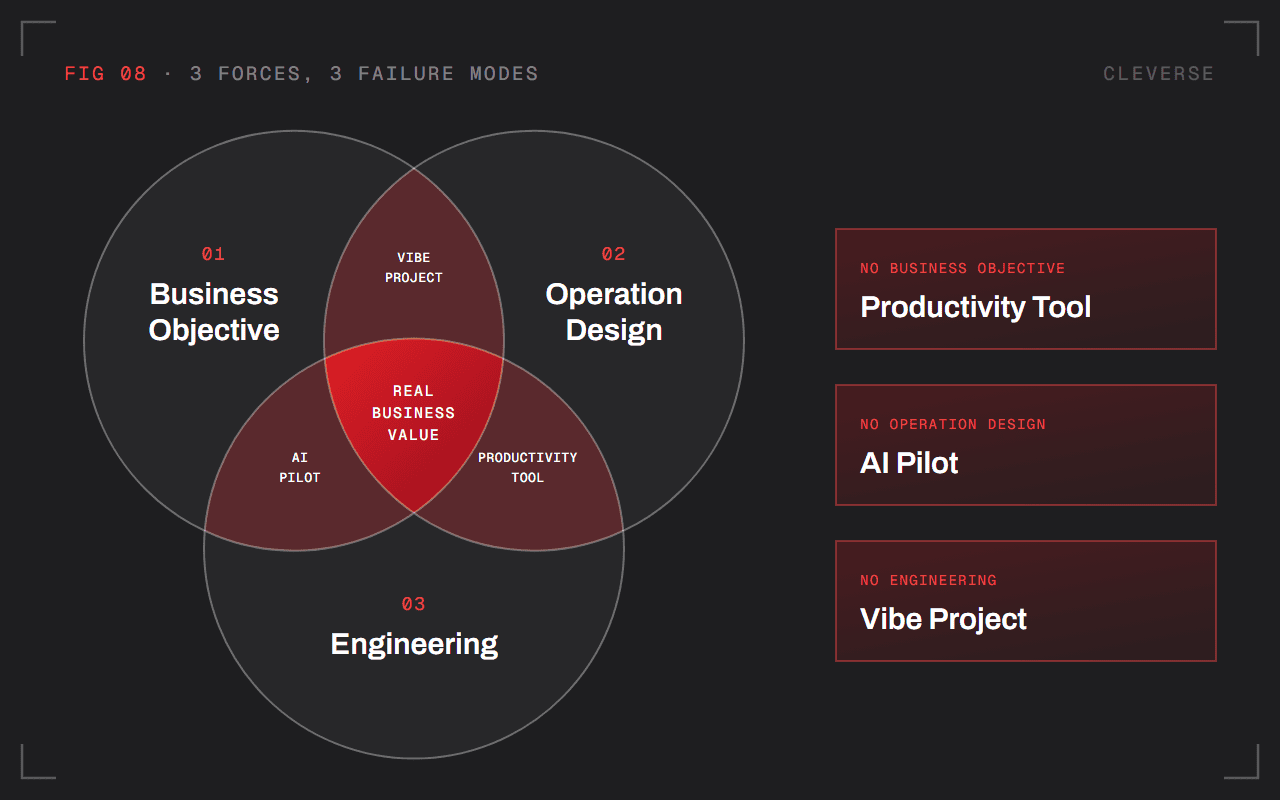
- Productivity Tool (no Business Objective): the system works and people use it, but no number leadership cares about moves. This is where "the ROI of AI feels intangible" comes from.
- AI Pilot (no Operation Design): the demo is impressive, but nobody owns the agent when it's wrong, so nobody dares put it into production.
- Vibe Project (no Engineering): the strategy is right and the new workflow is designed, but the system never survives real data, permissions, and integrations.
Why "Forward Deployed"
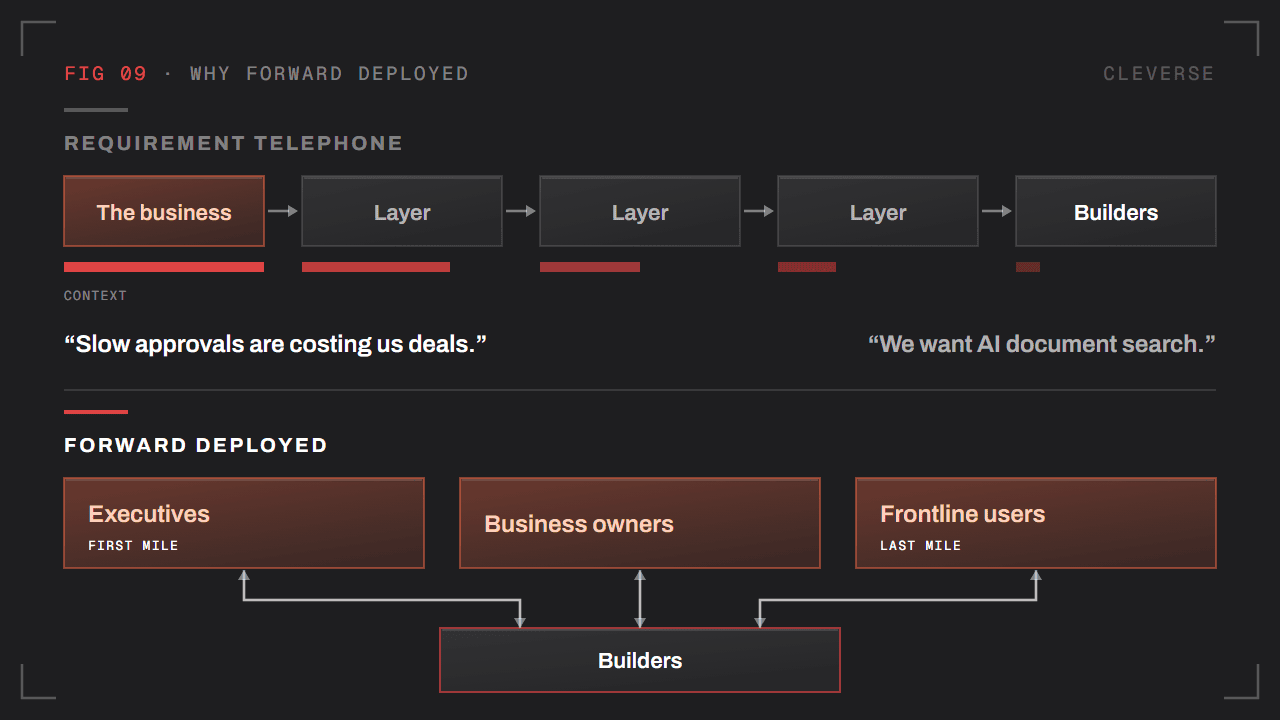
To pick the right problem, the team has to talk directly with three groups:
- People who set the goals — executives and the C-suite
- People who own the outcomes — business owners
- People who do the work — frontline users
Not just the IT team, and not through intermediaries. IT is still essential to building the system, but it can't be the only window into the business.
The Requirement Telephone
Requirements passed through several layers work like a game of telephone. Each layer strips out a little context. By the time they reach the builders, what's left is "we want AI document search," not "slow approvals are costing us deals."
Creativity only works at full power when you clearly understand the constraints: what's possible, and what shouldn't be done. Those constraints live with the people on the ground, not in a requirements doc.
The First Mile and the Last Mile
We focus on two moments:
- The First Mile — why invest, and what ROI to expect
- The Last Mile — whether the system actually helps people do their work
The First Mile lives in the executive room. The Last Mile lives on the front line. To connect them, the team needs access to and understanding of both, and that's never a one-time exercise.
From Spec-Driven to Move-In Driven
Enterprise AI rebuilding is a lot like designing and building a house. What you planned at the start runs into new constraints and insights once construction begins. Sometimes you redesign. Sometimes you change direction entirely.
The bigger the goal, the less clear the spec is upfront. That means this work can't follow a "deliver to spec and sign off" model.
Delivered to spec → People can actually move in
The cloud shifted software development from waterfall to iterative. AI is doing the same to enterprise deployment. That means the familiar procurement cycle of RFP, delivery, and sign-off may quietly become an obstacle.
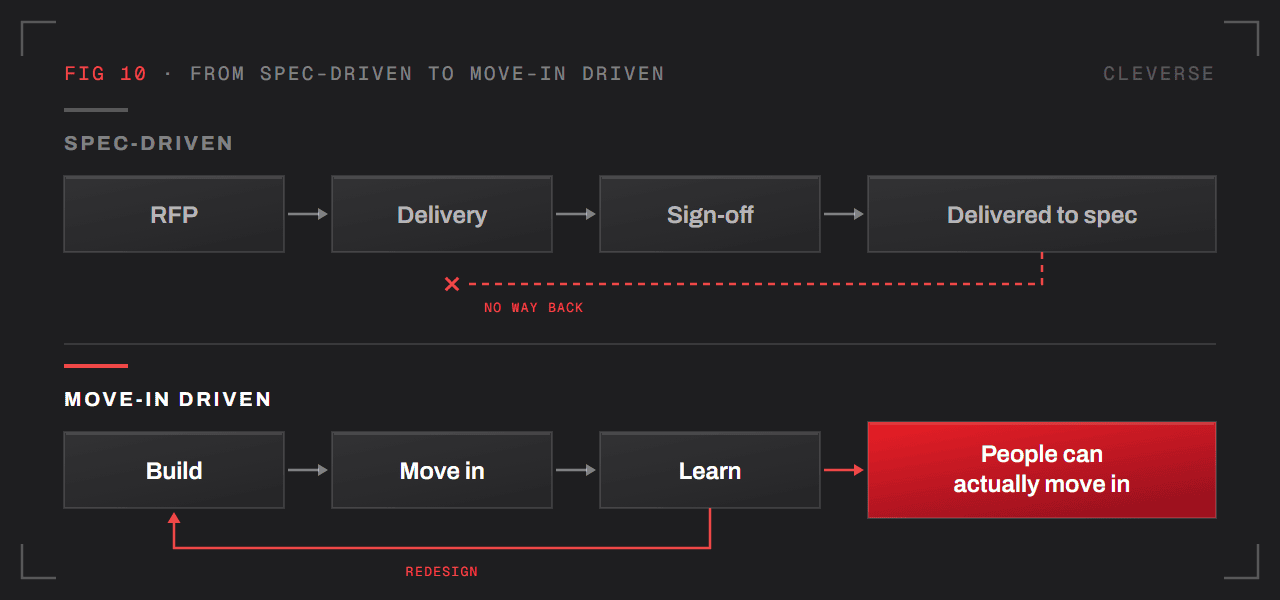
This is why the team building AI systems has to work continuously with executives, business owners, and real users. They can sit in the customer's office or collaborate another way. What matters is direct access to the work, the decisions, and the feedback, so both the problem and the solution can evolve along the way.
Forward deployed isn't about where you sit. It's about how close the builders are to the problem.
The FDE Role's Problem
Here's what one person would need to do all of this:
- Understand businesses across many industries quickly
- Understand what executives actually need
- Be practical enough to build things that work, while seeing impact across many dimensions
- Design operations for large organizations
- Keep up with AI as it changes constantly
- Have software engineering fundamentals strong enough to build real systems
These people exist. They're just extremely rare.
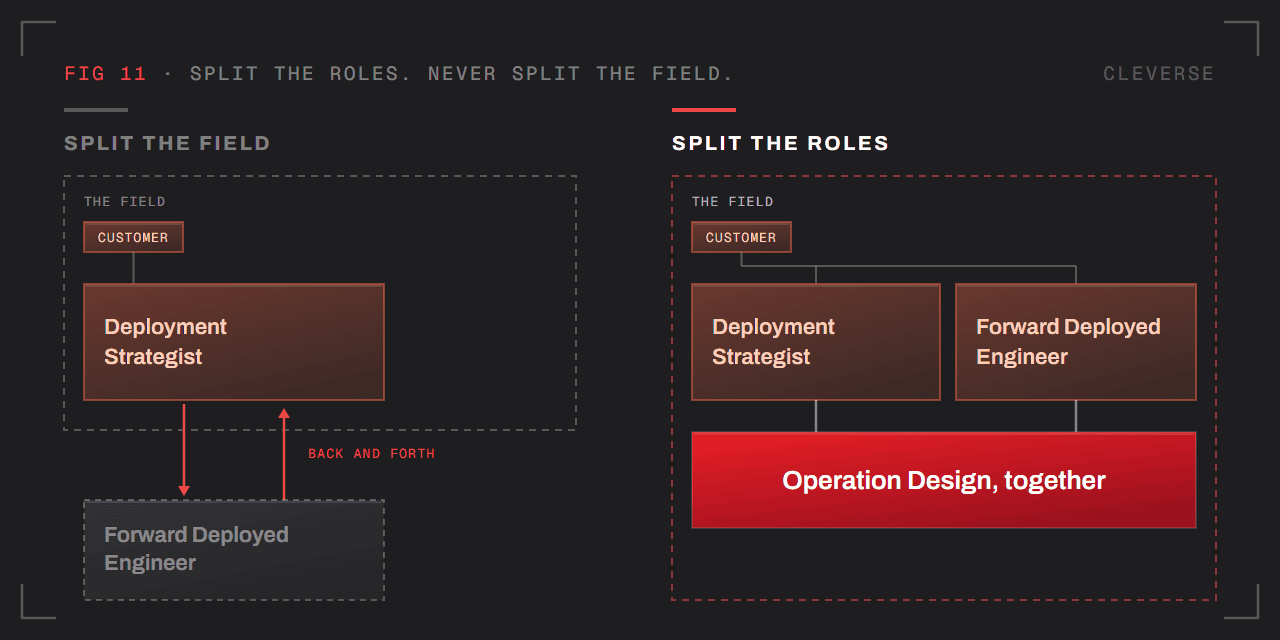
As customer demand grew, Cleverse tried to expand the team and found that one person who does it all is very hard to find. So we split the work into two roles:
| Deployment Strategist | Forward Deployed Engineer | |
|---|---|---|
| Core mission | Find the valuable goal | Build to run at scale |
| Primary force in the Triad | Business Objective | Engineering |
| Responsible for | Finding the business problem and defining the outcome | Designing and building systems that work in production |
Notice that Operation Design doesn't belong to either role. Both co-design the change together.
That's why both roles work directly with customers. If the Deployment Strategist goes on-site and hands requirements to an FDE sitting behind them, you've just rebuilt the Requirement Telephone inside your own team. Work bounces back and forth and never lands.
Split the roles. Never split the field.
This Is Just the Beginning
Before transforming your organization with AI, the key question isn't only "where do we find people who are great at building AI?" It's:
- Who will find the problems worth solving?
- Who will redesign how the work gets done?
- Who will be accountable for making the results real?
These questions will only matter more.
Every time models get better, the Engineering gets easier and cheaper. Business Objective and Operation Design don't. They depend on people, organizational politics, and context that isn't in any model's training data.
That means the bottleneck for enterprise AI is moving from "can AI do this?" to "do we know what to have it do, and is the organization ready to absorb it?"
The companies that understand this first won't win because they have better AI. They'll win because they pick better problems and change how they work faster.
What your organization needs isn't someone who calls themselves an FDE. It's people who can make all three of these things actually happen.
What your organization needs isn't someone who calls themselves an FDE. It's people who can make all three of these things actually happen.